
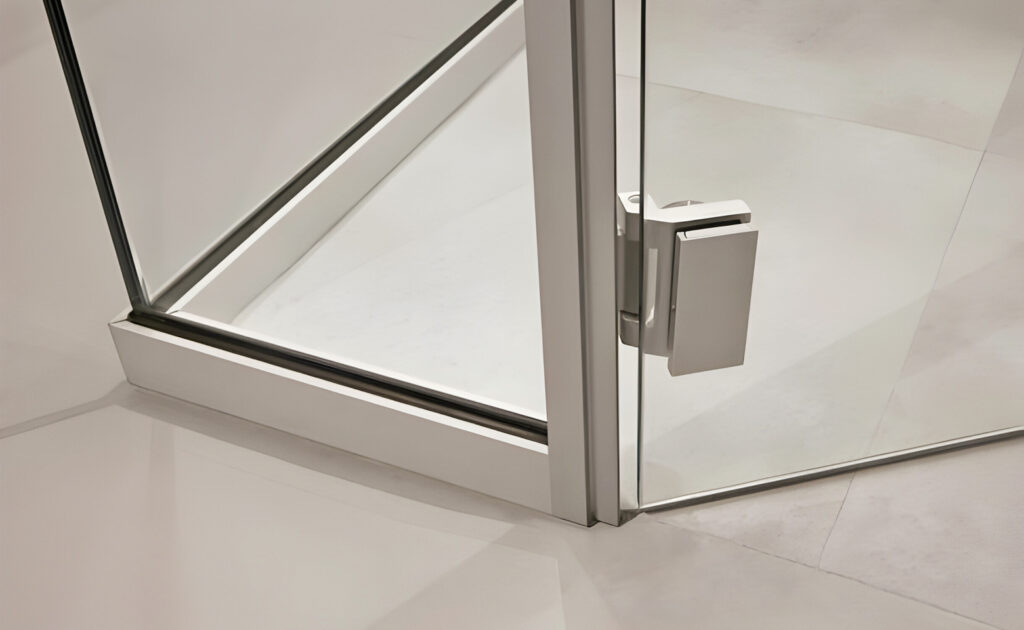
Choosing shower glass door hinges requires more than matching the finish to the bathroom. The mounting configuration, glass thickness, door weight, opening clearance, and installation details all affect which hinge is suitable.
This guide explains four common hinge configurations—glass to wall, offset wall to glass, glass to glass, and lift-off—and the information you should confirm before ordering.
For available models and specifications, explore our shower glass door hinges.
Types of Shower Glass Door Hinges
Glass to Wall Shower Door Hinges
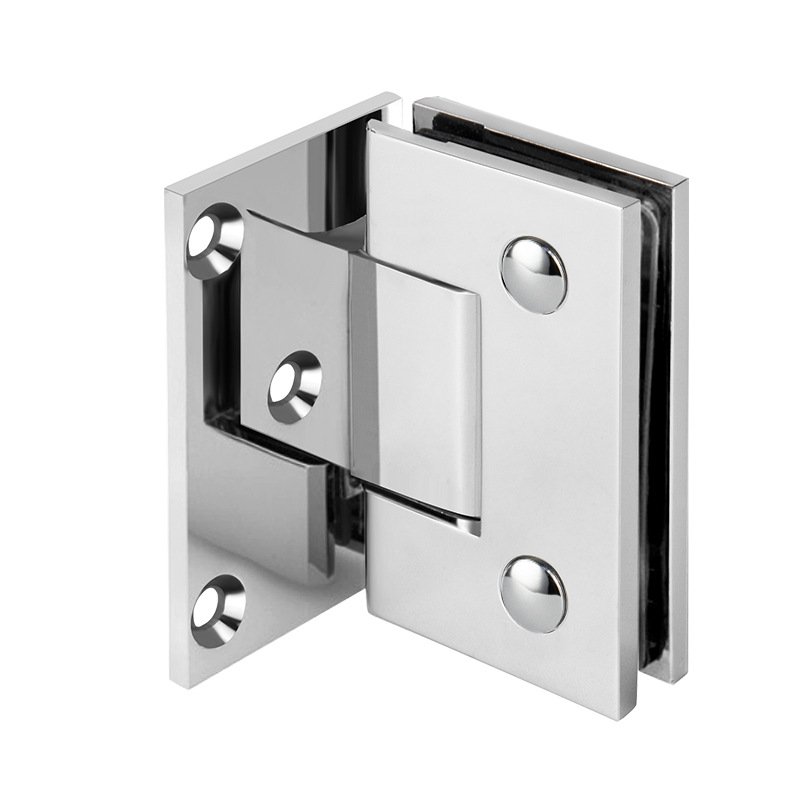
Glass to wall shower door hinges connect a glass door directly to an adjacent wall. They are commonly used where the enclosure layout allows the wall to support the hinged side of the door.
The wall-side mounting plate must be secured to a suitable structural substrate using fixings appropriate for the installation. Tile and surface finishes alone should not be treated as structural support.
Consider this configuration when:
The door is positioned next to a wall.
The wall construction can support the specified hinge fixings and door loads.
The door has sufficient clearance throughout its opening path.
Before ordering: Compare the mounting plate dimensions, fixing positions, glass cutout drawing, and permitted opening direction. Confirm that the selected model matches the door dimensions, glass thickness, and weight.
Offset Wall to Glass Shower Door Hinges
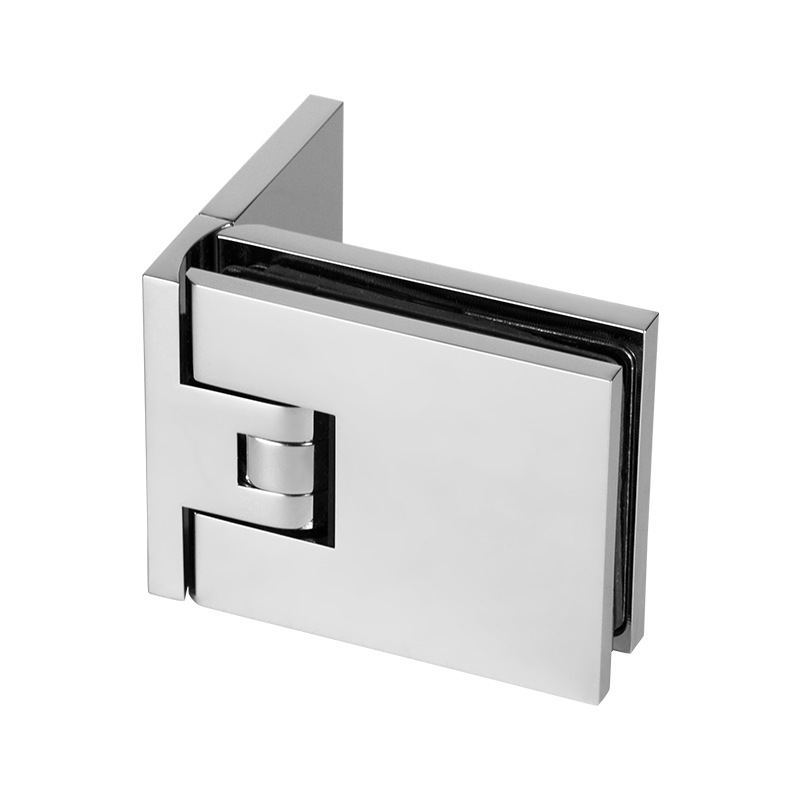
Offset shower door hinges use an offset mounting arrangement to accommodate particular glass-to-wall positions and fixing layouts.
They can be useful where a standard mounting plate does not suit the installation. However, an offset design does not automatically provide a wider opening or solve every clearance issue. Its suitability depends on the model’s geometry and the enclosure layout.
Consider this configuration when:
The required mounting plate position differs from that of a standard wall hinge.
A wall return, reveal, or nearby fitting affects the installation.
The project drawing calls for a specific offset arrangement.
Before ordering: Check the installation drawing against the actual wall position, fixing locations, and door swing. Confirm clearance around handles, seals, adjacent glass, and other bathroom fittings.
Glass to Glass Shower Door Hinges
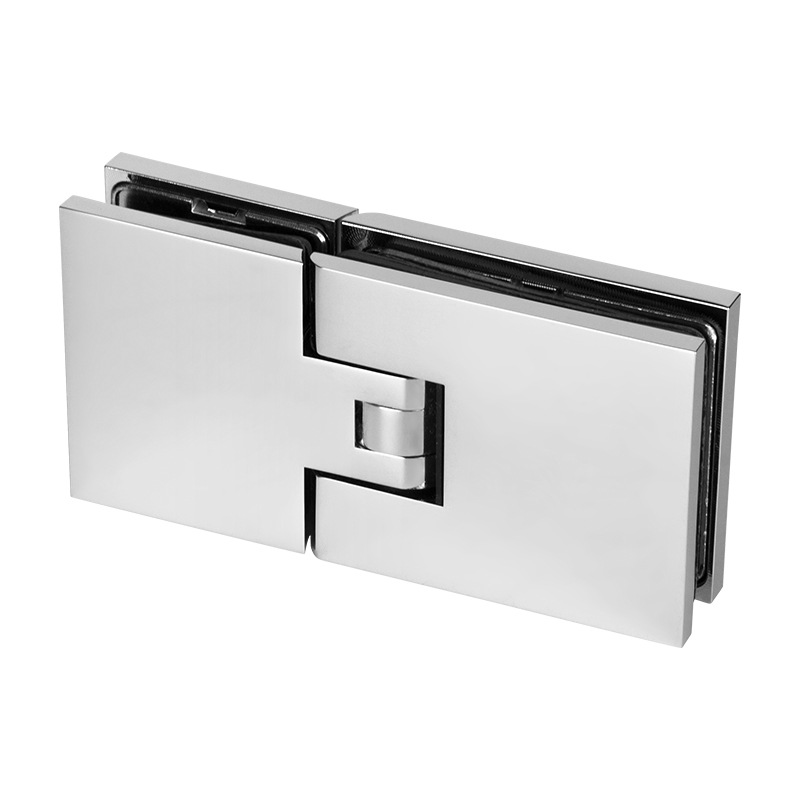
Glass to glass shower door hinges connect a moving glass door to a fixed glass panel. They are used where the enclosure design places a fixed panel beside the door instead of a wall.
Because the fixed panel receives loads from the moving door, its dimensions, anchoring, and any required supporting hardware must be considered as part of the complete enclosure.
Consider this configuration when:
A fixed glass panel sits beside the door.
The enclosure uses an inline or angled glass arrangement.
Direct wall mounting does not suit the layout.
Before ordering: Confirm the required panel-to-panel angle and the manufacturer’s definition of that angle. A product described as 90°, 135°, or 180° may refer to the installation geometry; it should not be assumed to describe the door’s permitted swing.
Check the glass preparation requirements for both panels and confirm how the fixed panel must be supported.
Lift-Off Shower Hinges
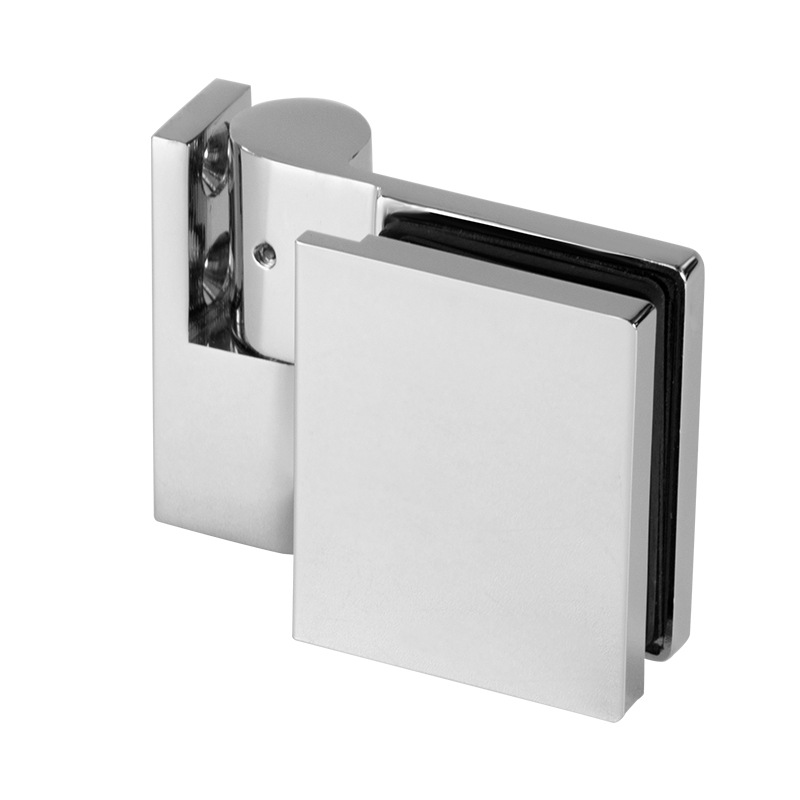
Lift-off shower hinges are designed to allow the door to be detached using a model-specific lifting or release procedure. They may be useful where planned access for servicing or replacement is an important part of the enclosure design.
Removal procedures vary. Do not assume that every lift-off hinge allows tool-free removal or that a glass door can be safely removed by one person.
Consider this configuration when:
The project requires a removable door.
There is sufficient clearance for the specified removal movement.
Maintenance personnel can safely support and handle the glass.
Before ordering: Confirm the removal procedure, required clearance, retention mechanism, and load rating. Follow the manufacturer’s handling and reinstallation instructions.
Shower Door Hinge Types at a Glance
| Hinge type | Connection | Main selection check |
|---|---|---|
| Glass to wall | Glass door to wall | Wall support, fixings, and mounting plate dimensions |
| Offset wall to glass | Glass door to wall using an offset arrangement | Offset geometry, fixing position, and clearance |
| Glass to glass | Glass door to fixed glass panel | Panel angle, glass preparation, and fixed-panel support |
| Lift-off | Model-dependent removable connection | Removal clearance, retention method, and safe handling |
Lift-off describes a removal feature rather than a single mounting configuration. Check the individual product drawing to establish how the hinge connects to the enclosure.
How to Choose the Right Shower Door Hinges
1. Confirm Glass Thickness and Preparation
The hinge must be specified for the actual glass thickness. Its gaskets, clamping components, and glass preparation must also match the manufacturer’s requirements.
Check:
Glass thickness and type.
Hole diameters and positions.
Cutout dimensions and corner radii.
Required clearances and edge distances.
Supplied gasket configuration.
Have the glass fabricator confirm the final preparation drawing before production. Holes and cutouts for tempered glass must be completed before tempering; tempered glass should not be cut or drilled on site.
2. Check Door Weight, Width, and Hinge Quantity
Door weight is only one part of hinge selection. Door width also affects the load applied to the hinges and supporting structure.
As an initial estimate, ordinary glass weighs approximately 2.5 kg per square metre for each millimetre of thickness.
For example, an 800 mm × 2,000 mm door made from 10 mm glass has an estimated glass weight of:
0.8 × 2.0 × 10 × 2.5 = 40 kg
This estimate excludes handles and other attached hardware. It does not establish which hinge model is suitable.
Check the manufacturer’s limits for:
Maximum door weight.
Maximum door width and height.
Glass thickness.
Required hinge quantity and spacing.
Permitted installation configuration.
Confirm whether a published load rating applies to one hinge, a pair, or a complete specified arrangement. Do not assume that adding another hinge increases the permitted load proportionally.
3. Verify Opening and Closing Behaviour
Before selecting a hinge, confirm how the door needs to move within the finished bathroom.
Review the permitted opening direction and angle, closing position, and any self-closing or adjustment features. These vary by model.
Check the full swing path against the wall, adjacent glass, handles, towel bars, shower fittings, and seals. The glass must not strike a hard surface during normal use.
4. Specify Material and Finish Separately
The hinge body material and decorative finish are separate specifications. A finish name such as chrome or matte black does not identify the underlying material.
Ask the supplier to confirm the body material, relevant corrosion-resistance information, and care requirements for the intended environment.
When coordinating hinges with handles, clamps, and support bars, compare physical finish samples where appearance is important.
5. Assess the Supporting Structure
A suitable hinge cannot compensate for inadequate support.
For wall-mounted installations, confirm the wall construction, anchoring method, and fixing requirements. For glass-to-glass installations, confirm that the fixed panel and its supporting hardware are suitable for the loads from the moving door.
Have a qualified installer review the complete enclosure when the supporting structure or mounting conditions are uncertain.
For a broader overview of mounting styles, finishes, and selection factors, read our guide to choosing shower door hinges.
Information to Provide When Requesting a Quote
To help a supplier identify a suitable model, provide:
An enclosure drawing showing fixed panels, walls, and door position.
Door width, height, glass thickness, and estimated weight.
Required mounting configuration and panel angles.
Opening direction and any clearance restrictions.
Existing glass cutouts, if selecting replacement hardware.
Preferred material, finish, and quantity.
Any special maintenance or removal requirements.
For replacement projects, include photographs and dimensioned drawings of the existing hinges and glass preparation. Visual similarity alone is not enough to establish compatibility.
Frequently Asked Questions
Are shower glass door hinges interchangeable?
Not necessarily. Models can differ in their mounting plates, hole positions, glass cutouts, load limits, and operating clearances. Compare the technical drawings before selecting a replacement.
How many hinges does a glass shower door need?
Use the quantity specified by the manufacturer for the door’s dimensions, weight, and mounting configuration. There is no single hinge count suitable for every glass door.
Do offset hinges always create a wider shower opening?
No. Their effect depends on the hinge geometry and the enclosure layout. Check the installation drawing and the resulting clear opening rather than relying on the product name.
Can I use the same hinges for different glass thicknesses?
Only if the manufacturer specifies compatibility with those thicknesses and provides the appropriate gasket arrangement. Do not substitute improvised packing materials.
Selecting a Compatible Hinge System
The right shower door hinge must suit the glass, supporting structure, mounting geometry, and intended door movement.
Start with an accurate enclosure drawing, compare the relevant product specifications, and confirm compatibility before the glass is fabricated or the hardware is ordered. This makes it easier to select components that fit correctly and support reliable operation.



 English
 German
 Spanish
 French